
Data-Driven Remediation: Grouping Students by Weakness Without Adding to Teacher Workload
Updated November 20, 2026: remediation is more than handing out the same questions again. Indonesia's 2025 Learning and Assessment Guide, a worked example of grouping students by topic from mock test results, a one-week plan, and lessons from TaRL.
Updated
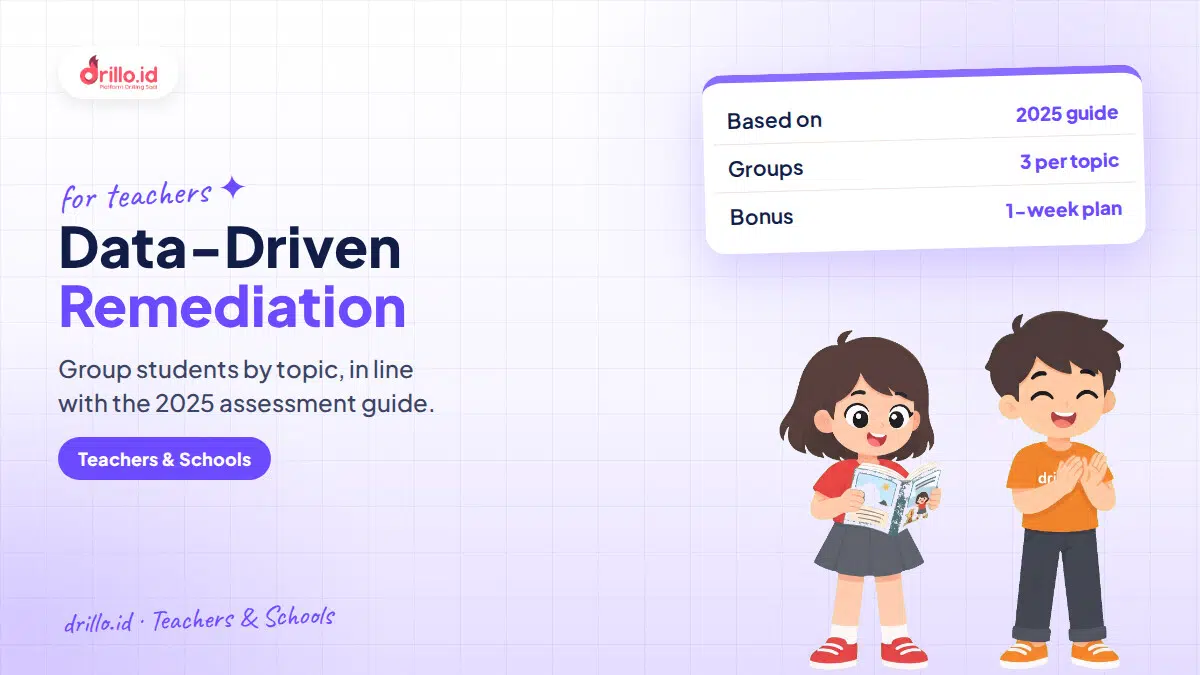
After every test or mock exam, teachers usually end up with a pile of scores but no time to turn them into a remediation plan. So remediation quietly becomes "do the same questions again". Yet the official guidance from Kemendikdasmen (the Ministry of Primary and Secondary Education) is clear that remediation is not simply repeating questions. This article looks at how to group students by weakness using data, drawing on official guidance and research, without adding to the administrative load teachers already carry.
A note on sources: quotations from Indonesian regulations, ministry press releases, and news reports in this article are our translations. The original wording is in the linked Indonesian sources listed under References.
Contents(13)ShowHide
Remediation is not just repeating questions
The Learning and Assessment Guide, 2025 revised edition, published by BSKAP (the Ministry's standards, curriculum and assessment agency), puts it this way:
"The aim of remediation is not only to improve marks, but to raise students' learning attainment. Remediation is therefore not carried out merely by giving out questions or tasks, but by supporting students to relearn the criteria of the learning objectives they have not yet met."
The same guide also corrects a common misreading of enrichment: "Enrichment does not mean giving students harder questions, but sharpening and broadening their knowledge through a range of references."
The key phrase is criteria not yet met. Effective remediation starts from knowing specifically which topic or criterion each student has not yet mastered.
Diagnostic and formative assessment as your data source
The guide treats the initial diagnostic assessment as the starting point: "Teaching and learning begins from the results of the initial learning assessment. Educators can deliver varied instruction (differentiated learning) in line with students' level of readiness and competence."
For formative assessment, the guide sets out several principles that actually lighten the load on teachers:
- Formative assessment is low stakes and "should not be used to determine report card grades, decisions on progression, graduation, or other high-stakes decisions".
- Formative assessment "can use simple methods so that feedback from the assessment can be obtained quickly".
- On the basis of assessment at the start of a learning sequence, educators need to adjust their lesson plans "and/or differentiate instruction so that it fits students' needs".
In other words, a short quiz or a mock test whose results can be processed quickly is enough to base grouping on, provided the results can be read topic by topic.
From scores to follow-up groups
The 2025 Learning and Assessment Guide gives example score bands along with the follow-up action for each. You can apply these bands per learning objective or per topic:
| Band | Attainment and follow-up (per the guide) |
|---|---|
| 0-20 | Learning objective not yet met; remediation by relearning all of the criteria |
| 21-40 | Learning objective not yet met; remediation by relearning most of the criteria |
| 41-60 | Learning objective almost met; remediation by relearning the criteria that need it |
| 61-80 | Learning objective met |
| 81-100 | Learning objective met; needs further challenge (enrichment) |
The guide also stresses that educators have latitude to set their own criteria and attainment scales as needed. So this table is an example, not a required benchmark.
The crucial move is to apply the bands per topic rather than to a total score. A student can sit in the 81-100 band for number work but in the 21-40 band for geometry. That way a single class splits into several small groups built around the specific topics that are weak, rather than just "passed" and "not passed".
Example: from mock test results to remediation groups
Suppose you have Mathematics mock test results broken down by topic. The table below uses six students as an illustration, not real school data. The figures are the percentage of correct answers per topic.
| Student | Number | Geometry and measurement | Data |
|---|---|---|---|
| Andi | 85 | 35 | 70 |
| Budi | 45 | 55 | 90 |
| Citra | 20 | 40 | 60 |
| Dewi | 90 | 85 | 95 |
| Eko | 60 | 30 | 50 |
| Fitri | 75 | 65 | 40 |
Using the guide's score bands, simplify into three groups for each topic:
- Full remediation (0-40): relearn all or most criteria with the teacher.
- Targeted remediation (41-60): focus on the specific criteria not yet met.
- Met and enrichment (61-100): move on, with extra challenge for scores of 81 and above.
For geometry and measurement, three students land in full remediation (Andi, Citra, Eko), even though Andi is strong in number. For data, only Fitri needs full remediation. The priority becomes clear: geometry and measurement needs a teacher-led session first, while data can be handled in a small group. Without topic-level data, Andi and Fitri might be treated as "passed" because their total scores look fine.
Sample one-week remediation plan
Here is a sample schedule you can adapt. The idea is that each group does a different activity in the same lesson time, so no extra teaching hours are needed.
| Day | Group | Activity |
|---|---|---|
| Monday | Full remediation | Relearn the concept with the teacher using concrete objects or pictures (about 30 minutes) |
| Tuesday | Targeted remediation | Practice questions on the unmet criteria, then go through the worked solutions (about 20 minutes) |
| Wednesday | Met and enrichment | Reasoning problems or a small project using other references, in line with the guide's meaning of enrichment |
| Thursday | All groups | Peer tutoring: students who have met the criteria support classmates on the same topic |
| Friday | All groups | Short re-quiz, then move students who have improved up to the next group |
Lessons from Teaching at the Right Level
The Teaching at the Right Level (TaRL) approach, developed by the Pratham organisation in India, follows similar logic. According to J-PAL, students are assessed with a simple tool and then grouped by their learning level rather than by age or grade. A student can move up to the next group as soon as they show progress. Six randomised evaluations across seven Indian states found the approach consistently effective. In a learning camp programme in Uttar Pradesh, the number of children able to read a paragraph or a story doubled.
J-PAL adds an important caveat: the TaRL components alone are not enough. Programmes succeeded when teachers were guided by clear objectives, helped to make sense of student learning data, and supported by ongoing mentoring.
Note: the TaRL evidence above comes from contexts in India and Africa, focused on basic literacy and numeracy. The 2025 Learning and Assessment Guide does not mention TaRL explicitly; its official term is differentiated instruction matched to students' level of readiness. Results in your school may differ.
Keeping the workload manageable
- One assessment, several uses. Use quizzes or mock tests that are already on the calendar as your data source, rather than adding new assessments.
- Automate item analysis. A platform that produces a topic-level summary saves time on marking and manual tallying.
- Limit the number of groups. Three groups (full remediation, partial remediation, enrichment) is usually enough to manage within one class.
- Share the load across teacher working groups. In the MGMP and KKG structures used by Indonesian schools, one teacher prepares remediation material for one topic and the group shares it.
- Reassess and move students between groups. As in TaRL, groups are temporary.
On funding, the 2026 technical guidelines for BOSP (the government operational funding scheme for schools) list "remedial teaching, enrichment teaching, and exam preparation" as eligible items under the teaching and learning component. The explanation is in our article on using BOS funds for digital learning platforms. For the national picture on TKA (Tes Kemampuan Akademik, the national academic ability test) results, see also a school strategy for raising TKA averages and the junior secondary Maths topics that need strengthening.
Frequently asked questions
Should remediation results replace report card grades?
The guide stresses that the goal of remediation is to improve learning, not just to fix grades. Formative assessment should not be used to determine report card grades either. Final grading policy still follows each school's own rules.
How many groups are ideal in one class?
The guide sets no fixed number, and teachers have flexibility to set criteria. In practice, three groups can usually be managed by one teacher without extra lesson time.
What if a student still has not met the goal after remediation?
Run another short assessment to see which criteria are still behind, then change the support, for example with different media or peer tutoring. As in TaRL, groups are temporary and should be reassessed regularly.
Topic-level difficulty maps from Drillo
Drillo.id provides practice questions and mock tests with worked solutions, results analysis by subtest and topic, and difficulty map reports for schools. Through the free Joint Tryout (Tryout Bersama), schools receive a PDF results report within 24 hours of the test, so teachers can see straight away which topics need remediation without tallying anything by hand. Students can also ask Tanya Drillo, an AI explainer that answers in text and voice, while they work back through the solutions.
You can request a free Joint Tryout for your school or first see a sample report and how the school tryout works (in Indonesian).
References

Written by
Sarah Sasmita
Penulis Informasi dan Edukasi Drillo.id
Membahas informasi pendidikan, tips dan strategi belajar, persiapan ujian dan seleksi, sampai pengembangan kompetensi dan karier. Fokusnya TKA, UTBK-SNBT, sekolah kedinasan, CPNS dan PPPK, BUMN, serta TOEFL. Menyajikan informasi yang mudah dipahami dan mengacu pada sumber tepercaya.