
TKA Grade 6 Math Questions with Explanations: 8 Practice Questions for Home
Updated November 18, 2026. Eight TKA grade 6 Math questions covering all three content areas and three formats, adapted from the TKA SD 2025/2026 item analysis questions, with answers, explanations, and tips for parents.
Updated
Grade 6 students, moms, and dads: the most honest way to check readiness for the TKA Math test is to work through real-style questions and see exactly where the answers go wrong. This article gives you the material: eight Math questions with pictures, answers, and explanations written in plain language.
The questions below were adapted by the Drillo.id academic team from the TKA SD 2025/2026 item analysis (daya serap) questions released by Pusmendik, then reworked based on a Bloom's taxonomy analysis. Their style and difficulty are close to the TKA, but they are not copies of the questions that will appear on the test. Each explanation also shows why the other options look right but are wrong, so parents can help even if elementary math was a long time ago.
Note on language: the real TKA is written in Indonesian and uses a comma as the decimal separator (for example, 2,5 means 2.5) and a period as the thousands separator (40.000 means 40,000). We translated the questions in full but kept the numbers in the Indonesian format so your child sees them the way they appear on the test.
How to use this: ask your child to answer all eight questions first without looking at the answers, in about twenty minutes. Then check and discuss together. Want the full set? The other 22 questions are in the free TKA SD Math Tryout, complete with explanations and a results analysis.
Contents(17)ShowHide
A quick look at the TKA SD Math format
Before starting, here is a short overview of the actual test so your child knows what to expect.
- Length and time: 30 questions in 75 minutes.
- Three question formats: standard multiple choice (one correct answer), complex multiple choice where each statement is marked true or false, and complex multiple choice with more than one correct answer.
- Three content areas (elemen): Numbers (Bilangan), Geometry and Measurement (Geometri dan Pengukuran), and Data and Uncertainty (Data dan Ketidakpastian).
- Scores: TKA SD results are reported on a 0 to 100 scale for each subject, under Minister of Primary and Secondary Education Decree (Kepmendikdasmen) No. 56 of 2026.
A fuller explanation of the material and strategies is in our article TKA SD Math practice questions (in Indonesian), and examples of each question format are in TKA SD test blueprint and the 3 question formats.
Map of the 8 questions
These eight questions were chosen so that all three content areas and all three formats are represented.
| No | Content area | Format | What it tests |
|---|---|---|---|
| 1 | Numbers | Multiple choice | Comparing fractions, decimals, and percentages |
| 2 | Numbers | Choose more than one | Sharing equally and finding factors |
| 3 | Numbers | True/false | Evaluating information with simple operations |
| 4 | Geometry and Measurement | Multiple choice | Finding the duration of an activity from analog clocks |
| 5 | Geometry and Measurement | Multiple choice | Perimeter of an irregular polygon |
| 6 | Geometry and Measurement | True/false | Properties of plane shapes: sides, vertices, and right angles |
| 7 | Data and Uncertainty | Multiple choice | Reading a bar chart to solve a problem |
| 8 | Data and Uncertainty | Choose more than one | Interpreting a chart to make a decision |
Numbers questions
Question 1 (Numbers, multiple choice)
Electricity in Indonesia comes from many kinds of power plants. Together, these plants produce 40.000 megawatts of electricity. The picture below shows the share of electricity produced by each type of power plant.
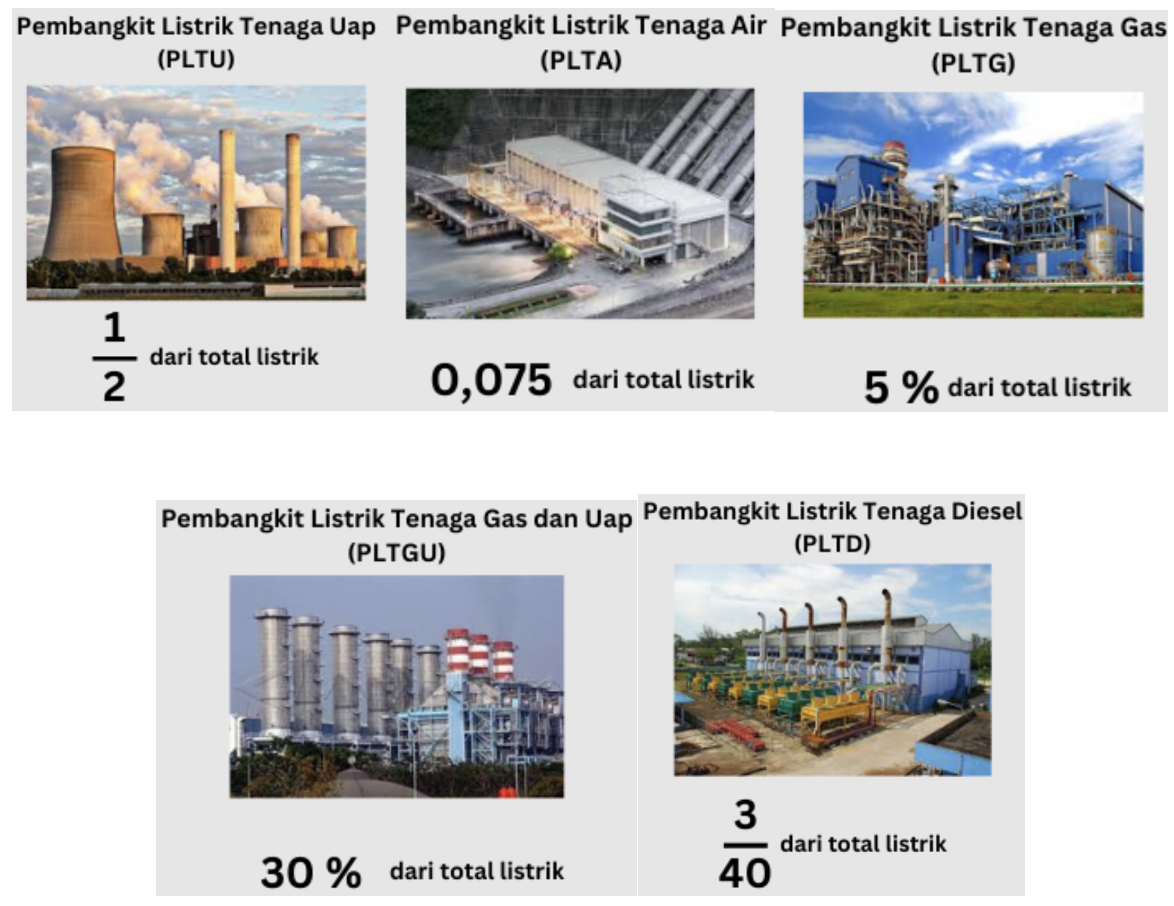
The type of power plant that produces the most electricity is ....
- A. PLTA (hydro)
- B. PLTG (gas)
- C. PLTU (steam)
- D. PLTGU (combined gas and steam)
Answer: C (PLTU).
Explanation: numbers written in different forms cannot be compared directly. First convert them all to the same form, for example percentages.
- PLTU: 1/2 = 50%
- PLTA: 0,075 = 7,5%
- PLTG: 5%
- PLTGU: 30%
- PLTD: 3/40 = 0,075 = 7,5%
The largest is PLTU at 50%, or 20.000 megawatts out of 40.000 megawatts. The trap: 0,075 and 3/40 look "big" because of the 75 and the 40, and PLTGU at 30% stands out because of the percent sign. Only after putting them in the same form does the real order become clear.
Question 2 (Numbers, choose more than one)
A village government is giving rice to low-income families. The rice is packed in sacks of the same size, using one of the following types of sack.
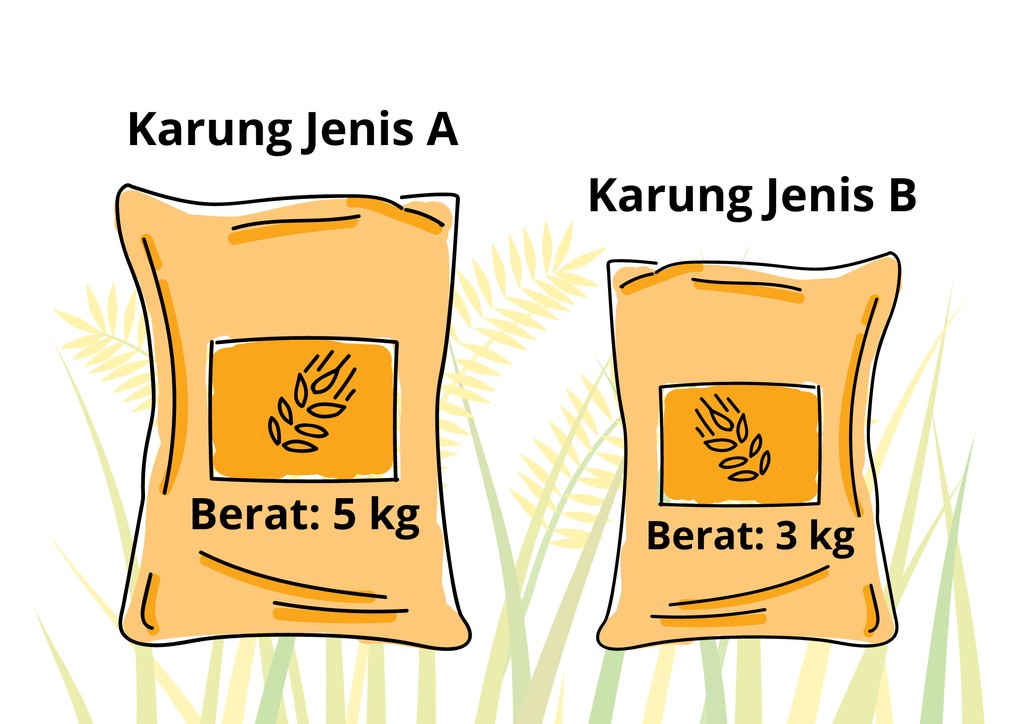
In January 2024, there are 150 sacks of rice to hand out. Every family receives the same number of sacks, and each family may receive more than one sack. How many families could receive rice in January 2024? More than one answer is correct.
- ☐ 30 families
- ☐ 25 families
- ☐ 20 families
Answer: 30 families and 25 families.
Explanation: since the sacks cannot be opened or split, the 150 sacks must be shared out with nothing left over. So we are looking for numbers that divide 150 exactly.
- 150 : 30 = 5, so each family gets 5 sacks. Possible.
- 150 : 25 = 6, so each family gets 6 sacks. Possible.
- 150 : 20 = 7,5, so each family would need half a sack. Not possible.
Notice that the sack weights (5 kg and 3 kg) are not used at all in this question. The TKA often shows extra information that is not needed. Teach your child to ask first: "What is the question actually asking?" before calculating with every number in sight.
Question 3 (Numbers, true/false)
Cheese can be made at home from fresh milk. Vinegar helps the milk protein settle into curds, while salt lowers the water content and also acts as a preservative. Below are the ingredients for one batch and the steps to make it.
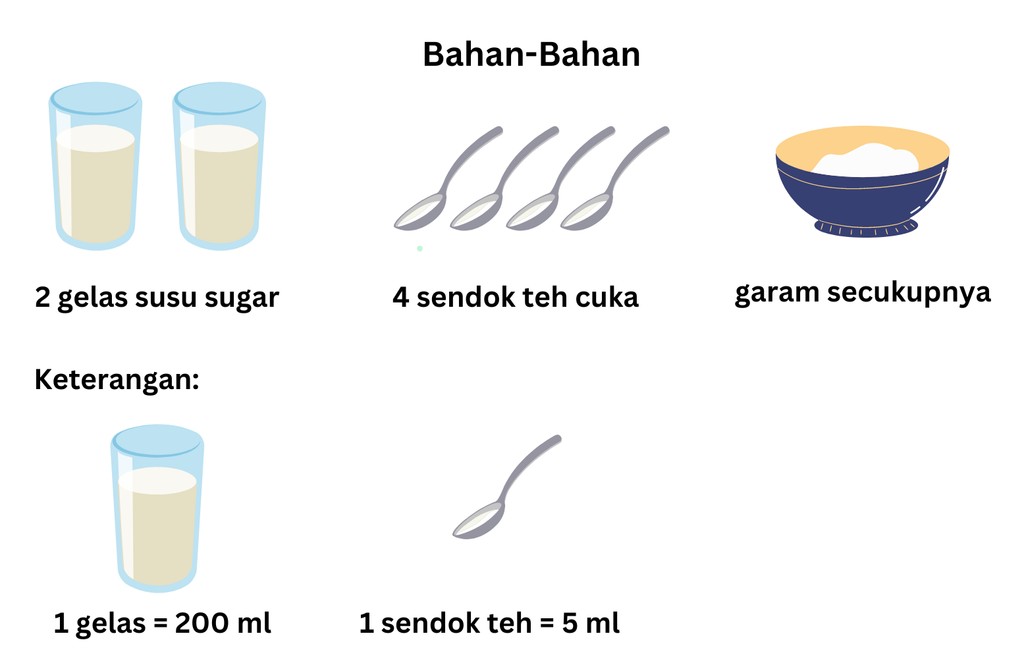
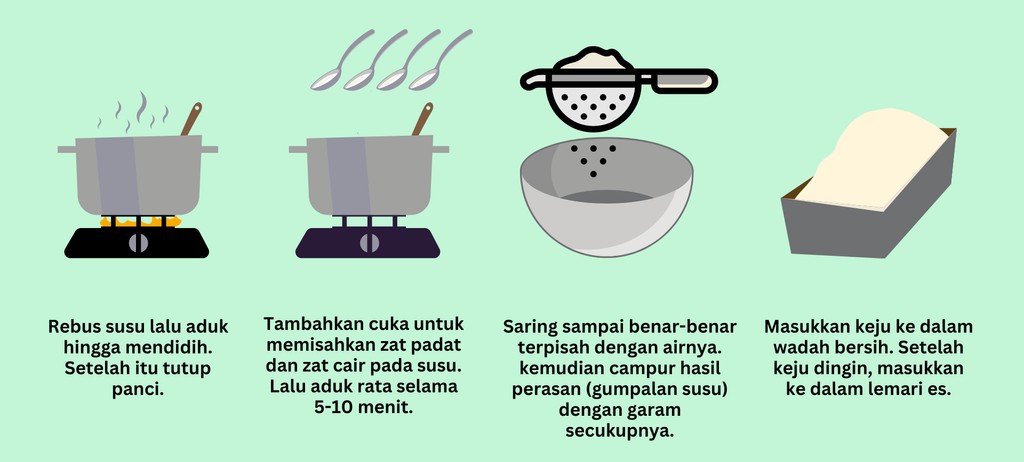
After calculating, one batch needs 4 g of salt. Someone wants to make 5 times the original recipe. They have 2.000 ml of fresh cow's milk, 140 ml of vinegar, and 16 g of salt. Are the ingredients enough? Mark each statement True or False.
| Statement | Answer |
|---|---|
| 20 g of salt should be prepared. | True |
| There is a shortage of 40 ml of vinegar. | False |
| No extra fresh cow's milk is needed. | True |
Explanation: work out what 5 batches need, then compare with what is available.
- Milk: 1 batch = 2 glasses = 2 × 200 ml = 400 ml. For 5 batches: 5 × 400 ml = 2.000 ml. They have 2.000 ml, exactly enough. So no extra milk is needed (True).
- Vinegar: 1 batch = 4 teaspoons = 4 × 5 ml = 20 ml. For 5 batches: 5 × 20 ml = 100 ml. They have 140 ml, so there is 40 ml extra, not a shortage (False).
- Salt: 5 × 4 g = 20 g. So 20 g is indeed what should be prepared (True). Having only 16 g means they are still 4 g short.
The second statement is a classic trap: the difference really is 40 ml, but in the opposite direction. Get your child into the habit of writing "need how much, have how much" before deciding whether something is short or extra.
Geometry and Measurement questions
Question 4 (Geometry and Measurement, multiple choice)
Mrs. Nina is cooking several dishes for relatives visiting from out of town. The clocks below show when she started and finished cooking.
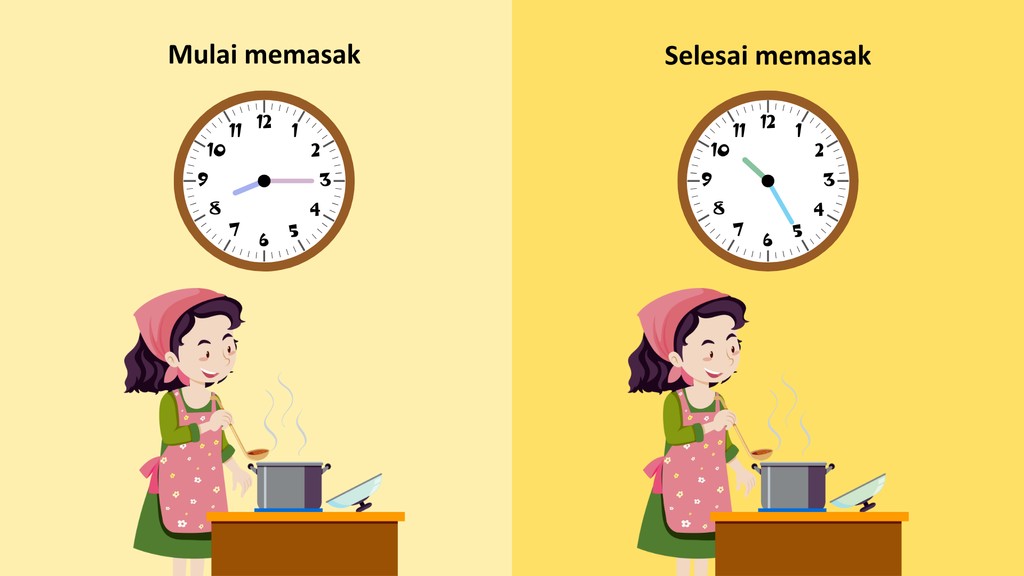
How long did Mrs. Nina spend cooking?
- A. 2 hours 10 minutes
- B. 2 hours 40 minutes
- C. 3 hours 10 minutes
- D. 3 hours 40 minutes
Answer: A (2 hours 10 minutes).
Explanation: read the long hand first, then the short hand.
- Start: the long hand points at 3, which means 15 minutes. The short hand is just past 8. So it is 08.15.
- Finish: the long hand points at 5, which means 25 minutes. The short hand is just past 10. So it is 10.25.
From 08.15 to 10.15 is 2 hours, and from 10.15 to 10.25 is 10 minutes. The total is 2 hours 10 minutes. A common mistake is reading the long hand at 3 as "3 minutes" or at 5 as "5 minutes". Remind your child that each number on the clock is worth 5 minutes for the long hand.
Question 5 (Geometry and Measurement, multiple choice)
The picture below shows a sketch of a plane shape with its measurements.
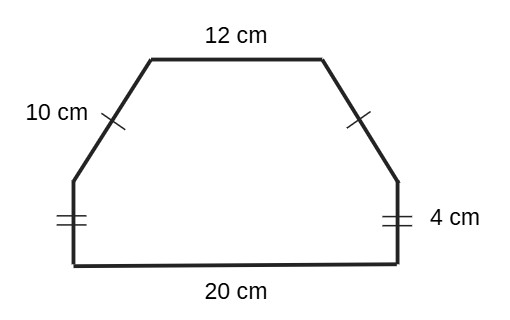
The perimeter of the shape is ....
- A. 46 cm
- B. 50 cm
- C. 56 cm
- D. 60 cm
Answer: D (60 cm).
Explanation: the perimeter is the total length of all sides. This shape has 6 sides, but only 4 numbers are written. The key is the small tick marks:
- Both slanted sides have one tick, so they are the same length: 10 cm each.
- Both vertical sides have two ticks, so they are the same length: 4 cm each.
Perimeter = 12 + 10 + 10 + 4 + 4 + 20 = 60 cm. Look at option A, 46 cm. That is what you get by adding only the written numbers (12 + 10 + 4 + 20). Distractors like this are placed on purpose for students who do not yet know what equal-side tick marks mean.
Question 6 (Geometry and Measurement, true/false)
A woodworker is making a wall decoration in the shape of the letter below. The letter is treated as a single plane shape.
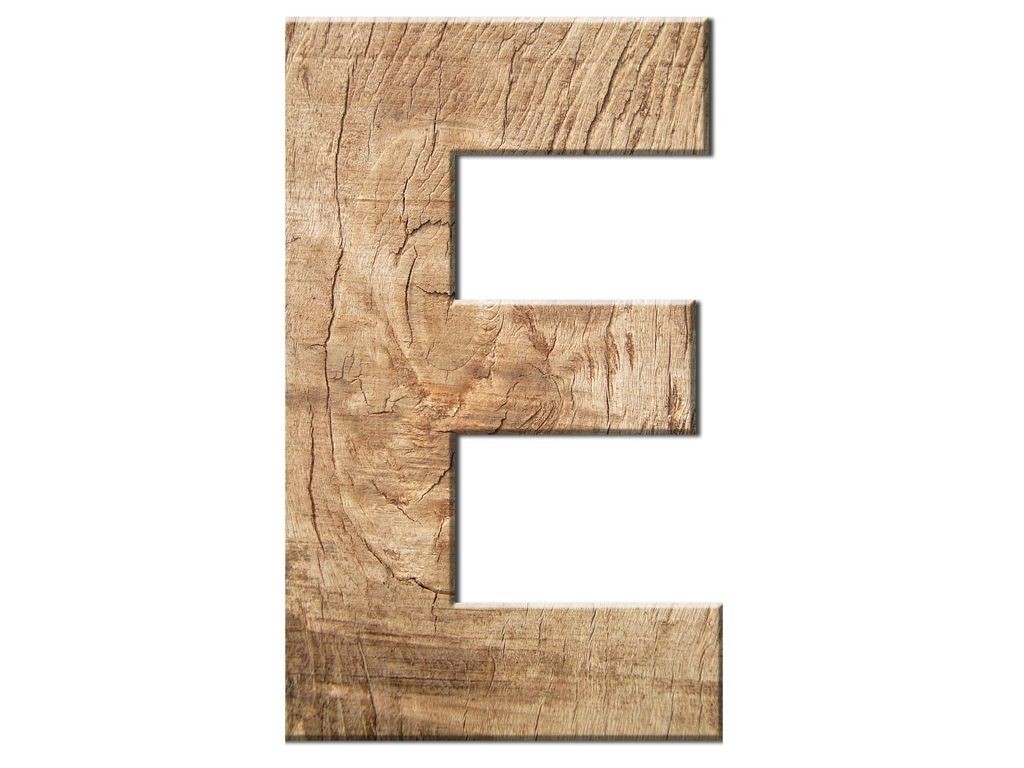
What are the properties of this wall decoration? Mark each statement True or False.
| Statement | Answer |
|---|---|
| It has 12 sides. | True |
| It has 12 vertices. | True |
| It has 10 right angles. | False |
Explanation: the safest way is to trace the edge of the E with a finger while counting, starting from the top left corner.
- Sides: there are 12 line segments around the E. In a closed plane shape, the number of sides always equals the number of vertices, so there are also 12 vertices.
- Right angles: of those 12 angles, 8 are outer corners measuring 90°. The other 4 are at the inner notches (to the right of the vertical bar, where the "arms" of the E meet it). Measured from inside the shape, each of those angles is 270°, not 90°. So there are 8 right angles, not 10.
Students who answer "True" for the third statement usually measure the notch angles from the outside. Remind your child that the angles of a plane shape are always measured from the inside.
Data and Uncertainty questions
Question 7 (Data and Uncertainty, multiple choice)
SD Pelita is taking a field trip by bus to the National Monument (Monas). Mr. Amir, a grade 6 teacher, records how many grade 6 students are going. Here is his data.
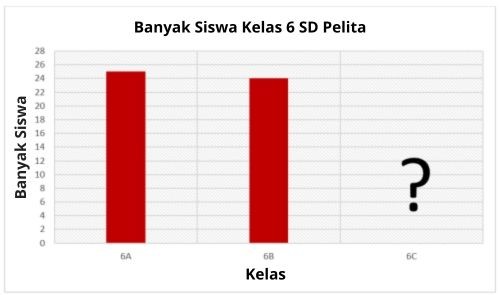
All grade 6 students ride 1 bus that holds at most 72 students, and no seats are left empty. How many students from class 6C are going on the trip?
- A. 22 students
- B. 23 students
- C. 24 students
- D. 25 students
Answer: B (23 students).
Explanation: "no seats are left empty" means the bus is full, with exactly 72 students. From the chart, class 6A has 25 students and class 6B has 24 students. So class 6C = 72 − 25 − 24 = 23 students.
Read the chart carefully: the grid lines on the vertical axis go up by 2. The 6A bar sits between the 24 and 26 lines, exactly at 25. Students who rush often read both bars as 24 or both as 25, and end up one off.
Question 8 (Data and Uncertainty, choose more than one)
Screen time is time spent watching TV, using a computer or laptop, playing games, using a phone, and similar activities. Too much screen time can be harmful, for example by causing nearsightedness. Siska's screen time limit is 2 hours on school days and 2,5 hours on holidays. Her school asks for a daily screen time report. Here is Siska's report.
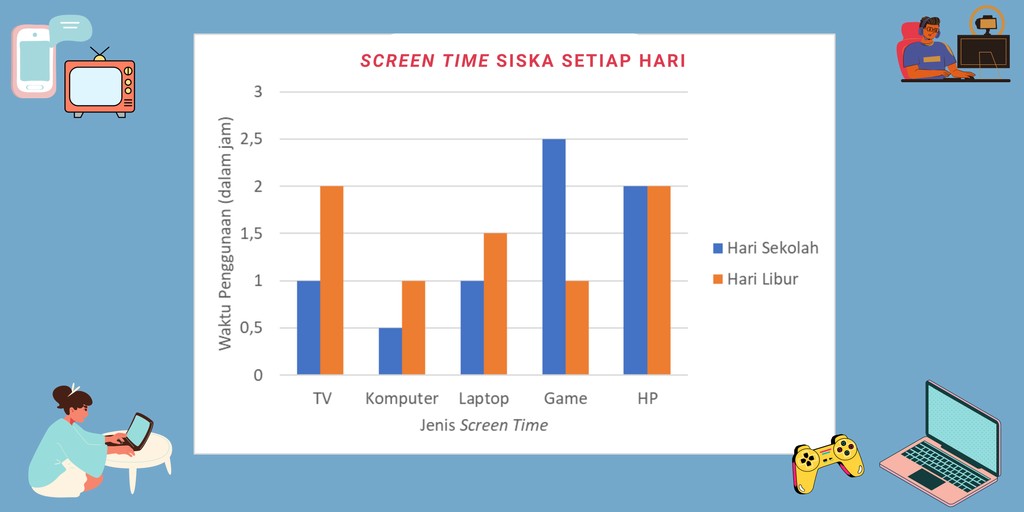
Siska has gone over her limit and is advised to cut down. By how much could Siska reduce her total screen time on a school day? More than one answer is correct.
- ☐ 6 hours
- ☐ 5 hours
- ☐ 4 hours
Answer: 6 hours and 5 hours.
Explanation: use only the blue bars (school days). TV 1 hour, computer 0,5 hour, laptop 1 hour, games 2,5 hours, and phone 2 hours. The total is 1 + 0,5 + 1 + 2,5 + 2 = 7 hours. The limit is 2 hours, so Siska must cut at least 7 − 2 = 5 hours.
- Cut 6 hours: 1 hour left. Under the limit, fine.
- Cut 5 hours: 2 hours left. Exactly at the limit, fine.
- Cut 4 hours: 3 hours left. Still over the limit.
Two traps here: reading the orange (holiday) bars by mistake, and using the 2,5 hour holiday limit. Ask your child to circle the words "school day" in the question before reading the chart.
The most common mistakes
- Comparing numbers in different forms without converting first. In question 1, 0,075 and 3/40 look large but are only 7,5%. Get your child used to converting everything to percentages or decimals before comparing.
- Only adding the numbers that are written. In question 5, ignoring the equal-side tick marks leads to 46 cm. In question 2, the opposite happens: some numbers (the sack weights) are not used at all. Teach your child to read pictures as carefully as sentences.
- Rushing through true/false questions. In question 3, the 40 ml difference is real, but the word "shortage" makes the statement false. One small word can flip the answer, so read every statement to the end.
Tips for parents
- Ask your child to explain the method, not just the answer. If they can describe the steps in their own words, the understanding is solid. If not, that is the part to revisit.
- Use things around the house. A wall clock for reading time, a measuring cup for milliliters, and food packaging for comparing percentages. TKA Math uses many everyday contexts like these.
- Practice complex multiple choice on purpose. For true/false and choose-more-than-one questions, have your child mark every item before deciding, so they do not stop after finding one correct answer.
- Look at the pattern of mistakes, not the number of mistakes. Many errors in questions 1 to 3 point to Numbers. Questions 4 to 6 point to Geometry and Measurement. Questions 7 and 8 point to chart reading.
- Keep the mood light. The TKA does not decide whether a child graduates. Children who practice without fear are usually more careful.
The full schedule is in the 2027 TKA SD and SMP schedule, and a guide for supporting your child is in the TKA SD guide for parents. For Indonesian language practice, continue with TKA Bahasa Indonesia grade 6 questions.
The other 22 questions are in the free TKA SD Math Tryout
These eight questions are only part of the set. The other 22 questions are in the free TKA SD Math Tryout, with the same number of questions and time as the real test: 30 questions in 75 minutes. Afterwards, you get an explanation for every question and a results breakdown by content area, so you know exactly which parts need more work. Note that the tryout is in Indonesian, just like the real TKA.
References
- Regulation of the Head of the Agency for Standards, Curriculum, and Education Assessment (BSKAP) No. 047/H/AN/2025 on the TKA SD/MI and SMP/MTs Assessment Framework, issued July 24, 2025
- Decree of the Minister of Primary and Secondary Education No. 56 of 2026 on Guidelines for Administering the Academic Ability Test (TKA) and the National Assessment (question formats, time allocation, and score reporting)
- Drillo.id: TKA SD Math practice questions
- Drillo.id: TKA SD test blueprint and the 3 question formats
- Drillo.id: 2027 TKA SD and SMP schedule

Written by
Sarah Sasmita
Penulis Informasi dan Edukasi Drillo.id
Membahas informasi pendidikan, tips dan strategi belajar, persiapan ujian dan seleksi, sampai pengembangan kompetensi dan karier. Fokusnya TKA, UTBK-SNBT, sekolah kedinasan, CPNS dan PPPK, BUMN, serta TOEFL. Menyajikan informasi yang mudah dipahami dan mengacu pada sumber tepercaya.