
TKA SMP Mathematics Practice Questions: Question Types, Strategies, and Worked Examples
TKA SMP Mathematics has 30 questions in 75 minutes, and the 2026 national average was only 40.34. Learn the four content areas and three cognitive levels in the Pusmendik framework, how complex multiple choice works, test strategies, and eight worked practice examples.
Updated
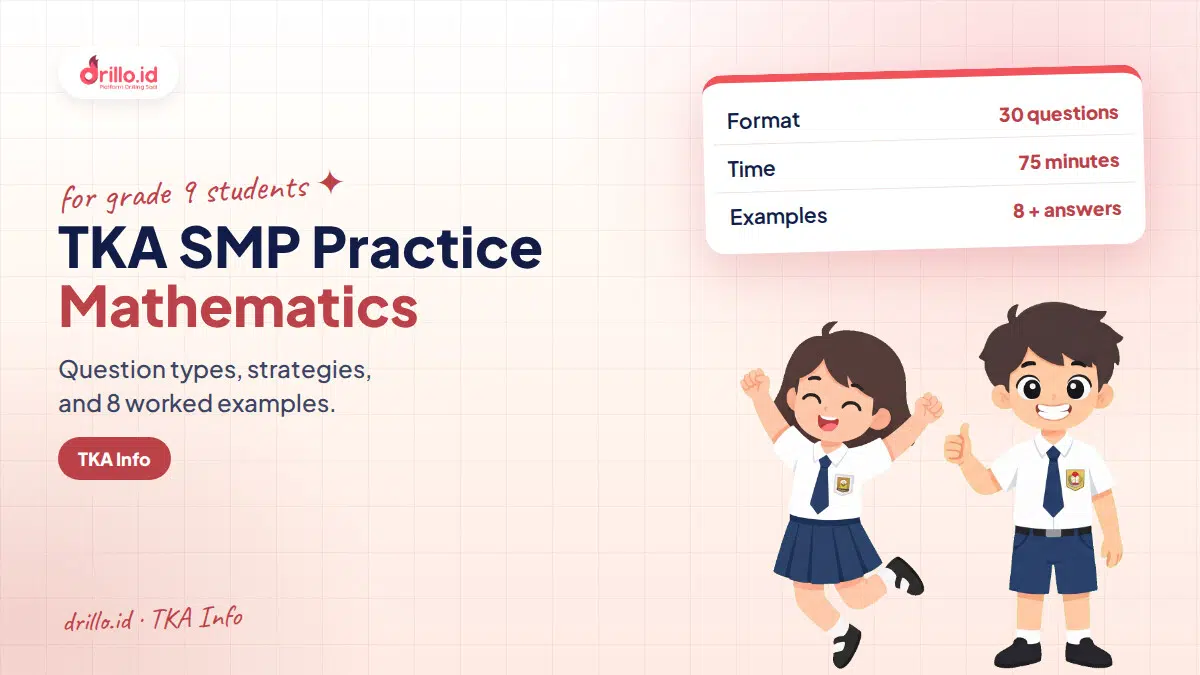
If you are in grade 9 now, Mathematics is probably the TKA subject you most need to prepare for. In TKA SMP 2026, the national Mathematics average was only 40.34, while Bahasa Indonesia (Indonesian language) averaged 60.83. This article covers what is tested, the question types, test-taking strategies, and eight practice examples with full explanations.
A quick note: TKA (Tes Kemampuan Akademik) is Indonesia's national academic ability test, and TKA SMP is the version for junior secondary school (grade 9). Descriptions of the official framework in this article are our translations; the Indonesian originals are listed under References.
Contents(16)ShowHide
The TKA SMP Mathematics format
TKA SMP tests two subjects: Bahasa Indonesia and Mathematics. According to the session schedule summarised by BBPMP East Java (the ministry's regional education quality assurance office), Mathematics has 30 questions to be answered in 75 minutes, or about 2.5 minutes per question on average.
TKA is not a graduation exam, as stressed in a Kemendikdasmen press release (Kemendikdasmen is the Ministry of Primary and Secondary Education). However, according to the press release on the 2026 TKA results, TKA scores (on a 0-100 scale, with an achievement category) are one component of the SPMB (Sistem Penerimaan Murid Baru, the state school admission system) achievement track, alongside report card grades and other achievements. We explain this in TKA SMP and the SPMB achievement track.
What is tested?
According to the TKA SMP assessment framework from Pusmendik (the ministry's Center for Educational Assessment), TKA Mathematics measures understanding of facts, concepts, principles, and procedures, as well as the ability to use them to solve problems. There are four content areas:
| Content area | Example subtopics in the assessment matrix |
|---|---|
| Number | Operations on real numbers; estimation; prime factorisation; ratio, scale, and rate of change; direct and inverse proportion |
| Algebra | Linear equations and inequalities in one variable; systems of linear equations in two variables; algebraic expressions; relations and functions; sequences and series |
| Geometry and measurement | Angle relationships; the Pythagorean theorem; congruence and similarity; nets; transformations; perimeter, area, and volume |
| Data and probability | Presenting data; mean, median, mode, and range; probability of a single event |
The same framework sorts questions into three cognitive levels: knowledge and understanding (calculating, reading a table or graph), application (turning a word problem into a mathematical sentence), and reasoning (analysing, evaluating, and drawing conclusions).
Question types you should know
The sample SMP Mathematics questions on the Pusmendik website use three types:
- Multiple choice (Pilihan Ganda, PG): choose the single best answer from four options.
- Complex multiple choice, MCMA (multiple correct, multiple answers): more than one answer is correct, and you must select all of them.
- Complex multiple choice, category format: decide True or False for each statement.
In complex multiple choice, check every statement; do not guess from your first impression.
Strategies for TKA SMP Mathematics
- Turn the story into a model. Define your variables, then write the equation before you start calculating.
- Master the foundations. Fractions, percentages, ratios, and algebraic operations show up in many other questions.
- Tell direct and inverse proportion apart. Ask yourself: when one quantity goes up, does the other go up too, or does it go down?
- Keep your pace. Flag any question that takes more than three minutes, move on, and come back to it at the end.
Practice examples with explanations
Note: The questions below are practice examples, not official TKA questions. They were written by the Drillo team to illustrate the content areas and cognitive levels in the TKA SMP assessment framework.
Example 1 (multiple choice, algebra)
Museum tickets for 2 adults and 3 children cost Rp95.000. Tickets for 1 adult and 2 children cost Rp55.000. The price of 1 child ticket is ....
A. Rp10.000
B. Rp15.000
C. Rp20.000
D. Rp25.000
Answer: B. Let the adult price be and the child price be :
Multiplying the second equation by 2 gives . Subtracting the first equation gives . Option D is the adult ticket price ().
Example 2 (complex multiple choice MCMA, data)
The test scores of seven students are 6, 8, 7, 9, 7, 5, 7. Select all the true statements.
(1) The mode of the data is 7.
(2) The median of the data is 7.
(3) The range of the data is 3.
(4) The mean of the data is greater than 7.
Answer: (1) and (2). Sorted data: 5, 6, 7, 7, 7, 8, 9. The mode and the median are both 7. Range . Mean , exactly 7, not greater than 7.
Example 3 (complex multiple choice, category format, Pythagorean theorem)
A 5 m ladder leans against a vertical wall. The foot of the ladder is 3 m from the wall. Decide True or False.
(a) The top of the ladder is 4 m above the ground.
(b) If the foot of the ladder is moved to 4 m from the wall, the top is 3 m above the ground.
(c) The farther the foot of the ladder is from the wall, the higher the top of the ladder.
Answer: (a) True, (b) True, (c) False.
If the foot is moved to 4 m from the wall, the height is m. The farther the foot of the ladder, the lower the top actually is.
Example 4 (multiple choice, inverse proportion)
Renovating a classroom can be finished in 12 days by 6 workers. To finish it in 8 days, with every worker working at the same rate, the number of workers needed is ....
A. 3 workers
B. 4 workers
C. 9 workers
D. 18 workers
Answer: C. The sooner the job must be done, the more workers are needed, so this is inverse proportion. Total work worker-days, then workers. Option B comes from mistakenly using direct proportion.
Example 5 (multiple choice, number and everyday arithmetic)
Mr Rudi buys a dozen books for Rp60,000, then sells each book for Rp6,000. If all the books are sold, his percentage profit is ....
A. 10%
B. 12%
C. 20%
D. 25%
Answer: C. Sales , so the profit is .
Percentage profit:
Option B comes from reading the Rp12,000 profit directly as a percentage.
Example 6 (complex multiple choice MCMA, algebra)
Given the equation , select all the true statements.
(1)
(2)
(3)
(4) The value of is 31.
Answer: (1), (2), and (4). Collect like terms: , so . Then and . Statement (3) is false because .
Example 7 (complex multiple choice, category format, probability)
A die numbered 1 to 6 is rolled once. Decide True or False.
(a) The probability of rolling an even number is .
(b) The probability of rolling a number greater than 4 is .
(c) The probability of rolling a 7 is .
Answer: (a) True, (b) True, (c) False. There are three even numbers (2, 4, 6), so the probability is . Two numbers are greater than 4 (5 and 6), so the probability is . There is no 7 on the die, so the probability is 0, an impossible event.
Example 8 (multiple choice, similarity)
A photo 4 cm wide and 6 cm tall is enlarged so that it is similar to the original. If the enlarged photo is 10 cm wide, its height is ....
A. 12 cm
B. 14 cm
C. 15 cm
D. 18 cm
Answer: C. In similar shapes, corresponding sides are in the same ratio.
Option A comes from adding the difference (), but similar enlargement uses multiplication, not addition.
Tips for parents
- Help your child map their weak spots with one practice set, then focus on the two or three topics they get wrong most often.
- Encourage 3-5 word problems a day, with the working written out.
- Check the SPMB guidelines (juknis) in your region so you know how TKA scores are used on the achievement track.
Note: Kemendikdasmen has set the official TKA SMP 2027 schedule: registration January 6 to February 7, SMP/MTs dress rehearsal February 15 to 18, the SMP/MTs test itself March 29 to April 1, 2027, make-up test April 19 to 22, and results announced May 14, 2027, as reported by Medcom. This is earlier than TKA SMP 2026, which ran April 6 to 16, 2026. Full details are in the official 2027 TKA calendar for primary and junior secondary school.
Measure your skills with a free tryout
Test yourself with a full set in the Free TKA SMP Tryout. It includes Mathematics and Bahasa Indonesia sets, each with 30 questions in 75 minutes, complete with explanations and a breakdown by subtest. Want to know which topics to work on first? Read the TKA SMP Mathematics topics you need to strengthen, then move on to TKA SMP Bahasa Indonesia practice questions.
References
- Pusmendik Kemendikdasmen - Kerangka Asesmen TKA Jenjang SMP/MTs/Sederajat: Matematika (in Indonesian)
- Kemendikdasmen - TKA SD dan SMP 2026 Digelar April, Kemendikdasmen: Pemetaan Mutu, Bukan Penentu Kelulusan (in Indonesian)
- Kemendikdasmen - Hasil TKA 2026 Resmi Dirilis, Kemendikdasmen Dorong Evaluasi Pembelajaran yang Lebih Presisi (in Indonesian)
- BBPMP Jawa Timur - Ini Jadwal Lengkap TKA SD dan SMP 2026 dan Sesinya (in Indonesian)
- Medcom - Jadwal TKA 2027 SD/MI dan SMP/MTs Diumumkan, Pendaftaran Dibuka 6 Januari (in Indonesian)

Written by
Sarah Sasmita
Penulis Informasi dan Edukasi Drillo.id
Membahas informasi pendidikan, tips dan strategi belajar, persiapan ujian dan seleksi, sampai pengembangan kompetensi dan karier. Fokusnya TKA, UTBK-SNBT, sekolah kedinasan, CPNS dan PPPK, BUMN, serta TOEFL. Menyajikan informasi yang mudah dipahami dan mengacu pada sumber tepercaya.