
TKA SD 2027 Blueprint for Mathematics and Bahasa Indonesia: Topics, 3 Question Formats, and Examples
Updated 24 November 2026. The TKA SD 2027 blueprint still follows Perka BSKAP 047/2025. Here are the Bahasa Indonesia and Mathematics topics, the three question formats including complex multiple choice, and practice examples.
Updated
Plenty of grade 6 students actually understand the material but still lose marks because they are not used to the question formats of the TKA (Tes Kemampuan Akademik, the national academic ability test). At primary (SD) level, not every TKA question has just one correct answer. This article walks through the content blueprint (kisi-kisi) and the three TKA SD question formats, with simple practice examples. It is written for grade 6 students and for the parents supporting them through TKA SD 2027.
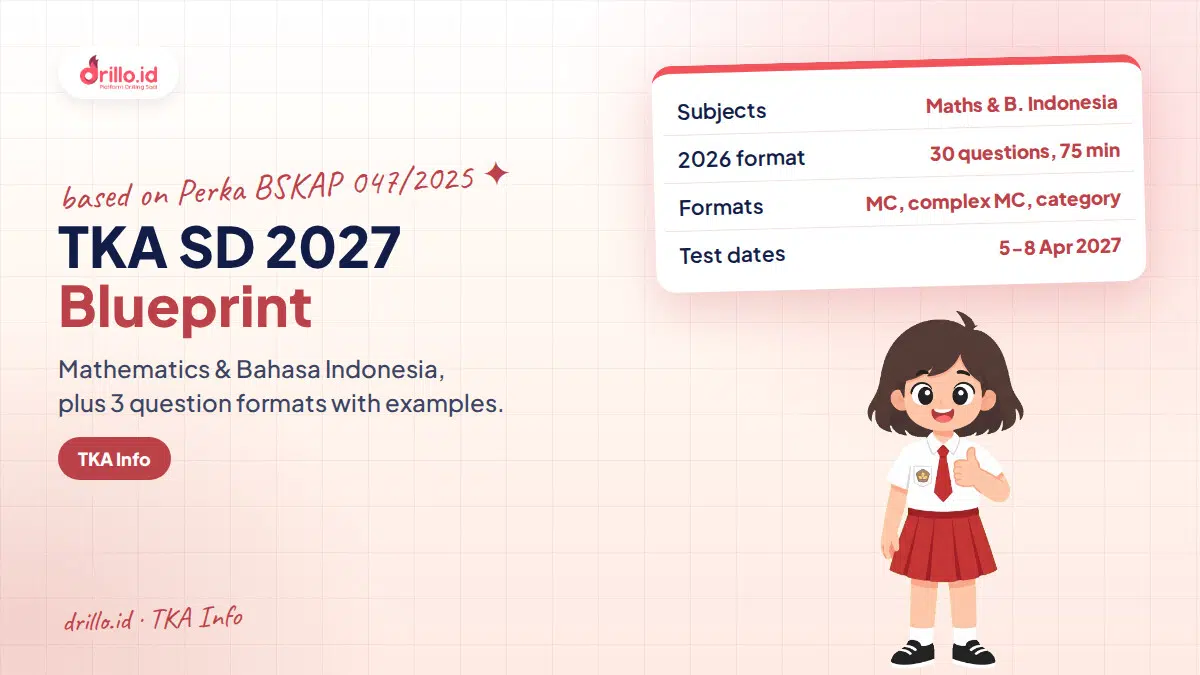
Short answer: as of 24 November 2026, no blueprint specific to TKA SD 2027 has been released. The official reference is still BSKAP Head Regulation No. 047/H/AN/2025 on the TKA Assessment Framework for SD/MI and SMP/MTs. The two subjects are Bahasa Indonesia (reading informational and fiction texts) and Mathematics (number, geometry and measurement, data), with three question formats: multiple choice, complex multiple choice, and the category format.
Contents(16)ShowHide
Is the TKA SD 2027 blueprint official yet?
No new assessment framework has been issued specifically for 2027. The reference document is still BSKAP Head Regulation No. 047/H/AN/2025 (Perka BSKAP), issued on 24 July 2025 and used for TKA 2026. According to a Kemendikdasmen media briefing on 9 November 2026, TKA SD/MI 2027 is scheduled for 5 to 8 April 2027, with registration opening on 6 January 2027. See the full timeline in our TKA SD and SMP 2027 schedule. We will update this article if a new framework is released.
TKA SD at a glance
TKA SD tests two subjects: Bahasa Indonesia (Indonesian language) and Mathematics. According to the schedule published by BBPMP East Java, each subject has 30 questions to be answered in 75 minutes, one subject per day. That works out to roughly 2.5 minutes per question on average. This is the 2026 format; the number of questions for 2027 has not been re-announced.
The official TKA SD content blueprint
The details below are summarised directly from Perka BSKAP No. 047/H/AN/2025.
Bahasa Indonesia
TKA Bahasa Indonesia at SD level focuses on reading skills. Two kinds of text are used: informational texts (simple facts from various fields, at local and national scale) and fiction (made-up stories, fantasy, or factual stories such as biographies, including poems). Texts are about 150 to 200 words long, with short sentences of 3 to 7 words.
| Competency | What is measured |
|---|---|
| Literal comprehension | Recognising general and subject-specific vocabulary, identifying objects from vocabulary, finding stated information, and turning a text into a summary or chart. |
| Inferential comprehension | Inferring the main idea, moral, characters, events, and values; inferring changes in objects, characters, or setting; explaining the meaning of expressions. |
| Evaluation and appreciation | Judging how events in a text relate to everyday life, checking consistency between pieces of information, and inferring emotional responses to fiction. |
Mathematics
TKA SD Mathematics follows both Kurikulum 2013 and Kurikulum Merdeka (the national curricula), with three content strands.
| Strand | Sub-strand | Topics covered |
|---|---|---|
| Number | Rational numbers | Equivalent fractions; comparing and ordering fractions; links between fractions, decimals, and percentages; operations with whole numbers; adding and subtracting fractions, multiplying and dividing fractions by whole numbers; multiples, factors, LCM, and GCF. |
| Geometry and measurement | Geometric objects | 2D shapes (triangles, quadrilaterals, polygons); building cubes, cuboids, and combined solids; front, top, and side views. |
| Measurement | Standard units and conversions for length, volume, mass, and time; speed; perimeter and area of 2D shapes; volume of cubes, cuboids, and combined solids; angles; estimating measurements. | |
| Data | Presenting and using data | Pictures, pictograms, bar charts, and frequency tables; extracting and using information from data. |
Each topic can be tested at three cognitive levels: knowing and understanding (calculating, reading tables or charts), applying (turning word problems into number sentences), and reasoning (analysing, solving non-routine problems, drawing conclusions). In TKA SD 2026, the national Mathematics average was 43.41, well below Bahasa Indonesia at 60.14, so Mathematics deserves a bigger share of practice time.
The three TKA SD question formats
According to Kompas TV, citing an explanation from Kemendikdasmen (the Ministry of Primary and Secondary Education), TKA for SD and SMP uses three question formats. All three are also listed in the TKA Assessment Framework from BSKAP. There are no short-answer or essay questions.
| Format | Key feature | What to watch out for |
|---|---|---|
| Simple multiple choice | Only one correct answer | Distractors that look very similar to the correct answer |
| Complex multiple choice (more than one answer) | More than one answer can be correct | Stopping after finding the first correct answer |
| Complex multiple choice, category format | Several statements judged one by one, for example True/False | Rushing and not reading each statement |
Practice examples (not official questions)
The examples below are practice items written by the Drillo team to illustrate each format. They are not official TKA questions. Example 3 is a Bahasa Indonesia reading item, so it is kept in Indonesian, just as it would appear in the test.
Example 1: Simple multiple choice
A cake is cut into 8 equal pieces. Dimas eats 2 pieces. What fraction of the cake did Dimas eat?
A. B. C. D.
Answer: B, because .
Example 2: Complex multiple choice (choose all correct answers)
Choose all the numbers that are equal in value to .
A. 0.5 B. 50% C. D. 0.25
Answer: A, B, and C. If you only chose A, your answer is incomplete.
Note: in the Indonesian test, decimals are written with a comma, so 0.5 appears as 0,5.
Example 3: Category format (True/False)
Rina menanam biji kacang hijau di atas kapas basah. Setiap pagi ia meneteskan air ke kapas itu. Pada hari ketiga, muncul akar kecil berwarna putih.
Tentukan Benar atau Salah untuk setiap pernyataan.
- Rina meneteskan air setiap pagi. (Benar/True: this is stated directly in the text)
- Akar muncul pada hari pertama. (Salah/False: the roots appear on the third day)
- Rina menjaga kapas tetap basah agar biji bisa tumbuh. (Benar/True: this is a conclusion drawn from the text)
In English: Rina places mung bean seeds on wet cotton wool and drips water onto it every morning; on the third day, small white roots appear.
Tips for each question format
- Read the instruction first. Phrases such as "pilih semua" (choose all) or "tentukan benar atau salah" (decide true or false) tell you which format you are dealing with.
- Check every option one by one in complex multiple choice questions. Do not stop at the first answer that feels right.
- Go back to the text for Bahasa Indonesia questions. Separate what is actually written from conclusions you draw yourself.
- Manage your time. If one question is taking too long, skip it and come back later.
For parents
Parents can help in simple ways: read a short story with your child, then come up with two or three True/False statements about it. For Mathematics, practise converting fractions into decimals and percentages, because this topic shows up in many different forms.
Common mistakes during practice
- Reading the question too quickly. Key words such as "kecuali" (except), "semua" (all), or "paling tepat" (most appropriate) are easy to miss.
- Not checking every option. On questions with more than one correct answer, missing just one makes your answer incomplete.
- Answering from personal opinion. In reading questions, your answer must be supported by the text, not by your own experience.
- Forgetting to simplify fractions. and have the same value, but the options may only list one of them.
- Using the wrong unit. Check whether the question asks for cm, m, or km.
A sample weekly practice routine
| Day | Activity |
|---|---|
| Monday and Wednesday | Read one short text, then answer 5 comprehension questions |
| Tuesday and Thursday | Practise 5 to 10 mixed Mathematics questions |
| Saturday | Complete one timed practice set, then go over the mistakes |
In closing
Knowing the question formats matters just as much as knowing the material. The more often you meet complex multiple choice questions, the more careful you will be on test day. Practise the different formats and check how ready you are with the free TKA SD tryout on Drillo.id, which includes an explanation for every question. Older siblings in junior secondary school can read the TKA SMP 2027 blueprint.
References
- BBPMP Jawa Timur - Ini Jadwal Lengkap TKA SD dan SMP 2026 dan Sesinya (in Indonesian)
- Kompas.com - Kisi-kisi TKA SD 2026: Materi Bahasa Indonesia dan Matematika (in Indonesian)
- Kompas TV - 3 Bentuk Soal TKA SD/MI dan SMP/MTs: Bukan Hafalan, tapi Mengukur Pemahaman (in Indonesian)
- Kompas.com - Nilai Rerata TKA SD SMP 2026 Diumumkan, Paling Rendah Matematika (in Indonesian)
- BSKAP Kemendikdasmen - Kerangka Asesmen Tes Kemampuan Akademik (047/H/AN/2025) (in Indonesian)

Written by
Sarah Sasmita
Penulis Informasi dan Edukasi Drillo.id
Membahas informasi pendidikan, tips dan strategi belajar, persiapan ujian dan seleksi, sampai pengembangan kompetensi dan karier. Fokusnya TKA, UTBK-SNBT, sekolah kedinasan, CPNS dan PPPK, BUMN, serta TOEFL. Menyajikan informasi yang mudah dipahami dan mengacu pada sumber tepercaya.