
Permendiktisaintek Number 3 of 2026: The New Rules Behind Indonesia's 2027 State University Admissions
Updated 17 November 2026. Permendiktisaintek Number 3 of 2026 is now in force, and the 2027 admissions cycle is the first to run under it. Here are the articles that reshape quotas, SNBP scoring components, test material, and independent admissions pathways.
Updated
While much of the public is still waiting for the 2027 SNPMB (the national university admission selection system) calendar to be released, the regulation that will actually govern next year's selection was issued early this year and has drawn remarkably little attention.
It is Permendiktisaintek Number 3 of 2026 (a regulation of the Minister of Higher Education, Science and Technology on university student admissions). It was enacted on 18 February 2026 and promulgated a day later in the State Gazette of 2026 Number 118. The regulation revokes the two earlier ministerial regulations that had served as the legal basis for SNPMB, namely Permendikbudristek Number 48 of 2022 and Number 62 of 2023.
Why does it only matter now? Article 45 states that admissions for the 2026/2027 academic year are still carried out under the previous rules. In other words, the selection round held in early 2026 still ran on the old framework, and the 2027 SNPMB cycle, for the 2027/2028 academic year, is the first to be governed by this new regulation.
A note on sources: quotations from Indonesian regulations, ministry press releases, and news reports in this article are our translations. The original wording is in the linked Indonesian sources listed under References.
Contents(9)ShowHide
Quotas for the three pathways, and one change that is easy to miss
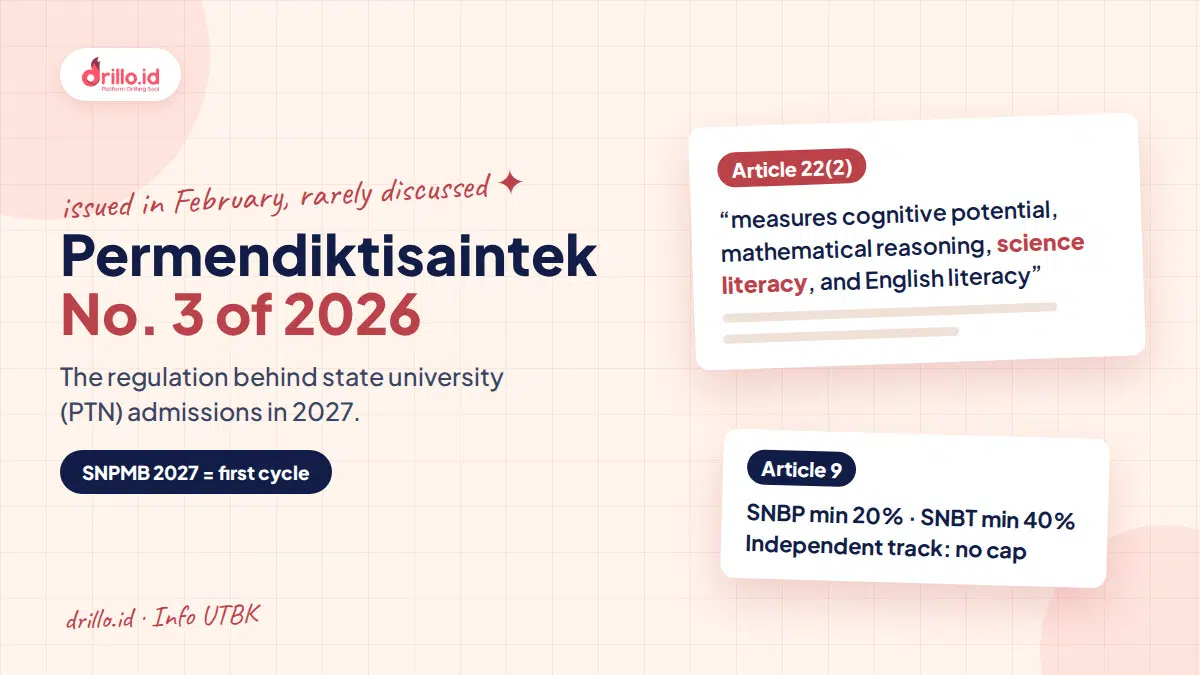
Article 9 governs how each PTN (a state university) must divide its intake capacity. The minimum figures are unchanged from the previous regulation.
| Pathway | Non legal entity PTN | Legal entity PTN |
|---|---|---|
| SNBP (the achievement based national selection, which uses school report cards) | At least 20 percent | At least 20 percent |
| SNBT (the test based national selection) | At least 40 percent | At least 30 percent |
| Independent admissions | The intake capacity not allocated to SNBP and SNBT | |
The real change sits in the independent admissions pathway. The old regulation set a maximum ceiling for it. The new Article 9 paragraph (5) only states that intake capacity not allocated to SNBP and SNBT is allocated to independent selection, without naming any ceiling figure.
In practice, as long as a state university meets the SNBP and SNBT minimums, what remains is at the institution's discretion. If you are preparing a fallback route, that is one more reason not to dismiss the independent pathway.
Another article that rarely gets attention, Article 7 letter a, requires every state university to admit at least 20 percent of students who have high academic potential but limited economic means, or who come from frontier, outermost, and underdeveloped regions, and that share must be spread across all study programmes.
SNBP scoring still rests on report cards and achievements
Article 15 sets two scoring components for SNBP, together making up one hundred percent:
- First component: the average report card score across all subjects, weighted at no less than 50 percent.
- Second component: report card scores for at most two subjects supporting the chosen study programme, plus portfolio and achievements, weighted at no more than 50 percent.
It is worth noting carefully that the TKA (Tes Kemampuan Akademik, the national academic ability test) is not mentioned anywhere in Permendiktisaintek Number 3 of 2026. The claim that 2027 SNBP applicants must sit the TKA comes from the Chair of the SNPMB Executive Team speaking in September 2026, and it has so far not been written into any ministerial regulation or into the 2027 SNPMB technical guidelines.
A fuller discussion of where the TKA stands is in our piece on the role of the TKA in the 2027 SNBP round.
The wording on test material has changed, but no new subtest structure has been announced
This is the section to read slowly. Article 22 paragraph (2) reads:
"The standardised computer based test referred to in paragraph (1) measures cognitive potential, mathematical reasoning, scientific literacy, and English language literacy."
Compare that with the 2026 UTBK (the computer based written test used in SNBT), which consisted of seven subtests: General Reasoning, General Knowledge and Understanding, Reading Comprehension and Writing, Quantitative Knowledge, Indonesian Language Literacy, English Language Literacy, and Mathematical Reasoning.
Two things differ. The phrase scientific literacy appears, with no direct counterpart in the 2026 structure, and Indonesian Language Literacy is not named in that article.
This is precisely where we need to hold back, and where you should be sceptical of any source that does not. The article governs the domains of ability being measured, not the names or the number of subtests. Subtests have always been set through SNPMB technical provisions, and SNPMB has not announced any change to the subtest structure for 2027.
The honest conclusion: the wording at the regulatory level has indeed changed and is worth monitoring, but there is no basis yet for saying that the 2027 UTBK will become a four subtest exam, or that Indonesian Language Literacy has been dropped. Until an official announcement arrives, the seven subtest structure remains a sensible basis for study. The details are in our guide to UTBK-SNBT material and its seven subtests.
Article 22 paragraph (3) also affirms that the test is held once within the running year.
Who may sit the test, and what is prohibited
- Article 24: SNBT candidates are final year school students in the running year, or graduates from at most the last three years. This provision is unchanged.
- Article 19: candidates declared accepted through SNBP may not register for SNBT. Choosing SNBP is therefore not a decision that can be reversed partway through.
- Article 25 paragraph (6): SNBT results are announced after the announcement of secondary school graduation.
- Article 25 paragraph (2): the test itself may be scheduled either before or after the announcement of secondary school graduation. This is new flexibility, and it means UTBK dates can no longer be inferred from the pattern of previous years.
The independent pathway, and a new opening for TKA scores
Article 32 paragraph (1) provides that independent selection is held after the SNBT results are announced. The sequence stays the same: SNBP, then SNBT, then independent admissions.
The interesting provision is Article 29 paragraph (3) letter b. For independent selection without a test, a state university is permitted to make use of academic ability test scores that it recognises.
The article does not name the TKA specifically, but it opens legal room for state universities to use academic ability test scores in test free independent admissions. For upper secondary and vocational school students, that means TKA scores may turn out to be useful beyond SNBP. To be clear, until individual universities announce their own policies, this is a possibility the regulation has opened up, not a certainty.
What this regulation does not cover
To keep expectations in the right place, the following are not set out in Permendiktisaintek Number 3 of 2026 and therefore still await the 2027 SNPMB technical provisions:
- The full 2027 SNPMB calendar, including account registration dates, application dates, and the UTBK sitting dates.
- The 2027 UTBK fee. For reference, the 2026 UTBK fee was Rp200,000, and it was free for KIP Kuliah (the government tuition assistance scheme) applicants.
- The number of study programme choices allowed. In 2026, candidates could select four study programmes.
- Rules on applying to a field outside one's school track, and the subtest structure.
A number of websites have already posted 2027 UTBK dates under an official sounding label. Be aware that the dates circulating are generally copied from the 2026 schedule. As of the date of this update, 17 November 2026, the official snpmb.id site still displays the 2026 calendar. Check there directly rather than relying on third party sites.
What this means if you are preparing
- Do not wait for the calendar before you start studying. Article 25 paragraph (2) makes the test date harder to predict from past patterns, not easier. What is certain is that the test is held only once a year.
- If you are aiming for SNBP, report cards remain the key. Article 15 places report card scores across all subjects at no less than half of the assessment. The TKA, according to statements by SNPMB officials, serves as a complementary validator rather than a replacement.
- Prepare for the independent pathway early. With the maximum ceiling gone, the size of the independent intake depends heavily on each institution's own policy.
- Study for the competency, not the format. Even if the subtest structure does change later, the reasoning and literacy abilities being tested are of the same kind.
Start by measuring where you stand
The quickest way to find out what needs work is to sit one full length practice set under proper timing, then look at which subtest came out weakest. Subtest by subtest practice can start with General Reasoning, Mathematical Reasoning, Indonesian Language Literacy, and English Language Literacy.
The study plan itself is in our 2027 UTBK preparation timeline, and the considerations behind choosing a pathway are in SNBP, SNBT, or independent admissions.
References
- Peraturan Menteri Pendidikan Tinggi, Sains, dan Teknologi Nomor 3 Tahun 2026 tentang Penerimaan Mahasiswa Baru pada Perguruan Tinggi (PDF) (in Indonesian)
- SNPMB - Laman resmi Seleksi Nasional Penerimaan Mahasiswa Baru (in Indonesian)
- SNPMB - Jadwal Penting (in Indonesian; still showing the 2026 calendar as of 17 November 2026)
- Panitia SNPMB - Paparan Konferensi Pers Hasil SNBT 2026 (25 Mei 2026) (in Indonesian)
- detikEdu - Ketua MRPTNI: Pendaftar SNBP 2027 Wajib Ikut TKA (3 September 2026) (in Indonesian)

Written by
Sarah Sasmita
Penulis Informasi dan Edukasi Drillo.id
Membahas informasi pendidikan, tips dan strategi belajar, persiapan ujian dan seleksi, sampai pengembangan kompetensi dan karier. Fokusnya TKA, UTBK-SNBT, sekolah kedinasan, CPNS dan PPPK, BUMN, serta TOEFL. Menyajikan informasi yang mudah dipahami dan mengacu pada sumber tepercaya.