
Part of the TKA Question Set for Grades 6 and 9 Is Written Locally: The Official Rules
Updated 17 November 2026. TKA question sets for grade 6 and grade 9 combine items written centrally with items written in the regions, unlike grade 12 where every item comes from the centre. Who writes them, the content rules, and what it means for students.
Updated
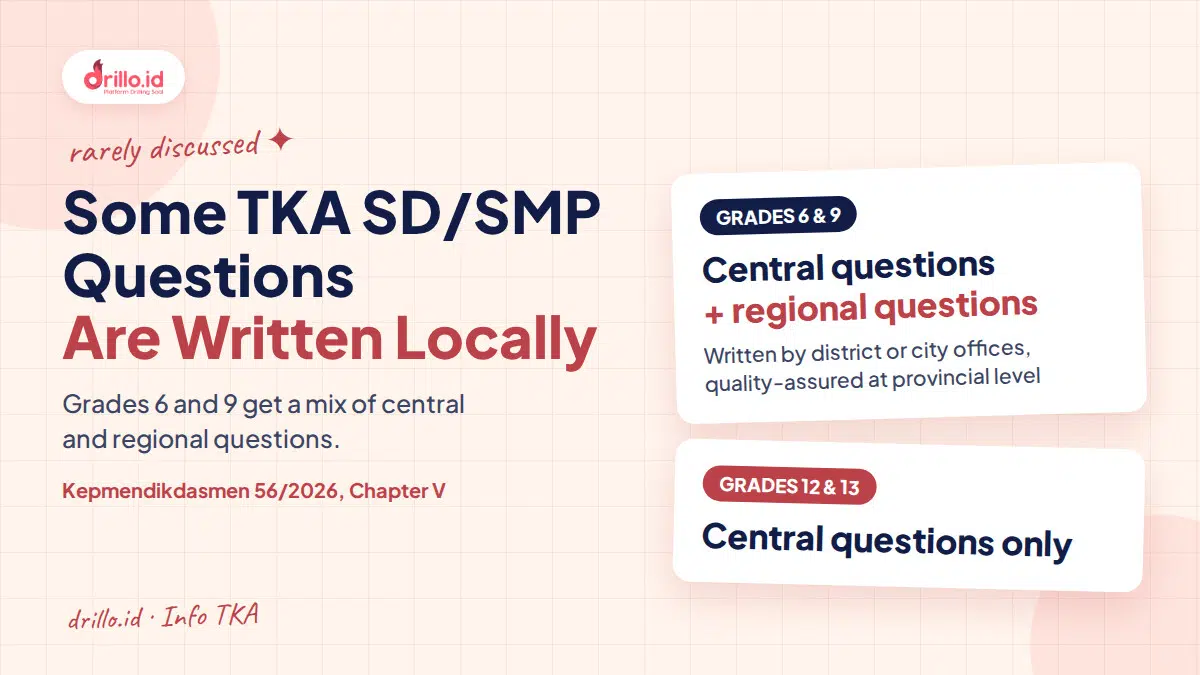
Many people assume every item on the TKA (Tes Kemampuan Akademik, the national academic ability test) is written in Jakarta and then sent out, identical, to every school. For SMA and SMK (senior secondary and vocational secondary school) that is indeed the case. But for grade 6 of SD (primary school) and grade 9 of SMP (junior secondary school), the question set is a mix of centrally written items and items written in the regions.
This arrangement is set out in Kepmendikdasmen Number 56 of 2026 (a decree of the Minister of Primary and Secondary Education) on guidelines for conducting the TKA and the AN (Asesmen Nasional, the national assessment), issued on 6 March 2026. Chapter V of that document deals specifically with the writing of regional items.
A note on sources: quotations from Indonesian regulations, ministry press releases, and news reports in this article are our translations. The original wording is in the linked Indonesian sources listed under References.
Contents(7)ShowHide
Who writes items for which year group
The split is laid out in the table of TKA and AN instruments inside the guidelines.
| Year group | Indonesian language and reading literacy | Mathematics and numeracy |
|---|---|---|
| Grade 6 and grade 9 | Central items and regional items | Central items and regional items |
| Grade 12, and grade 13 for four year SMK programmes | Central items | Central items |
It is worth noting that this pattern applies only to the TKA. Items for the National Assessment are still developed entirely by the ministry.
Why is there a grade 13? Because some vocational schools run four year programmes, so their final year is grade 13 rather than grade 12. The guidelines describe the test takers as grade 12 students in SMK/MAK three year programmes and grade 13 students in SMK four year programmes.
How regional items are written
The process is not simply handed to individual schools. The guidelines set out a tiered flow running from the district or city level up to the province.
- District or city education offices, together with the provincial education office, develop the Indonesian language and mathematics items for grade 6 and grade 9, using an item writing application provided by the ministry.
- The district or city office forms an item development committee with three areas of responsibility: drafting indicators, writing items, and reviewing items.
- The writers are teachers from schools who have experience in item writing and can operate a computer, assigned by the organising body at provincial or district and city level.
- Indicators are written on the basis of the item specifications set by the central organising body, covering competency, subject matter, cognitive level, and item format.
- The district or city office approves at least one item set per subject for each year group.
- The provincial office forms a quality assurance and item packaging committee, made up of subject leads together with teachers from schools and madrasahs who are strong in Indonesian language or mathematics. Subject leads may be senior teachers or university lecturers.
So the regions write the items, but the guardrails come from the centre. The item specifications, the competencies, and the cognitive levels are all set nationally.
The content rules writers must follow
Item writers and reviewers at district or city level are bound by a set of prohibitions written explicitly into the guidelines:
- No items containing ethnic, religious, racial, or intergroup bias, and nothing discriminatory, gender biased, violent, pornographic, provocative, or political.
- No use of the names of living figures, including politicians, public officials, and community figures.
- No images, sentences, or slogans containing advertising, commercial products, or the names of institutions.
- No plagiarism and no copying items from other sources.
- References must be cited, from valid and credible sources.
- Confidentiality must be maintained, and items that have been written must not be circulated.
One requirement stands out: every committee member and official involved must sign a statement that they are not affiliated with any tutoring agency, test preparation agency, or textbook publisher. In other words, the rules deliberately separate TKA item writers from the test preparation industry.
For the sake of disclosure, Drillo.id is a practice question platform and is not involved in writing TKA items at any level, central or regional.
What this means for students and parents
A reasonable question follows: if part of the question set is written regionally, does that make the TKA in Bali and in East Nusa Tenggara unequal?
The thing to understand is that what differs is the individual items, not the assessment framework. The competencies measured, the cognitive levels, the item formats, the time allocation, and the score scale are all set nationally. The timing is the same across Indonesia: 10 minutes of practice, 75 minutes for the subject test, and 20 minutes for the survey each day, under the same guidelines. Results are likewise reported on a scale of 0 to 100 for all primary and junior secondary test takers.
There are three practical consequences.
- Practice should still target competencies, not guesses about specific items. Because indicators are derived from central item specifications, mastery of the material and reasoning ability are far more useful than memorising last year's question types.
- The contexts may feel closer to home. Items written by teachers in a given region are likely to use contexts and situations familiar to local students. That works in favour of students who are used to reading long texts and working out the context.
- Be wary of claims about leaked items. Writers and reviewers are bound by a duty of confidentiality. If anyone offers a particular region's item set in the run up to test day, that is against the rules and should be treated with suspicion.
For schools, teachers, and education offices
For teachers, this scheme opens the door to taking part directly as an item writer or reviewer, provided they have item writing experience, can operate a computer, and receive an assignment from the organising body at provincial or district and city level.
For schools, the more pressing issue is technical readiness. The guidelines set a maximum computer ratio of one to four, meaning one computer for four test takers across four consecutive sessions, with delivery either online or semi online. The schedule and session details are covered in our piece on the 2027 TKA schedule for primary and junior secondary.
Practise the competency, not the guesswork
Because what is measured is competency, the most sensible way to prepare is to practise in the same format and duration as the real thing, then check which topics produce the most errors.
- Grade 6: free primary school TKA mock test
- Grade 9: free junior secondary TKA mock test
The topics most in need of attention, based on the 2026 national TKA averages, are summarised in our piece on the junior secondary TKA topics that need shoring up. The item formats, including complex multiple choice, are covered in the primary school TKA item specifications and formats.
References
- Keputusan Menteri Pendidikan Dasar dan Menengah Nomor 56 Tahun 2026 tentang Pedoman Penyelenggaraan Tes Kemampuan Akademik dan Asesmen Nasional, issued 6 March 2026 (Chapter IV instrument table, Chapter V regional item writing, Chapter VII facilities, Chapter VIII schedule) (in Indonesian)
- Peraturan Kepala Badan Standar, Kurikulum, dan Asesmen Pendidikan Nomor 047/H/AN/2025 tentang Kerangka Asesmen TKA SD/MI dan SMP/MTs, issued 24 July 2025 (in Indonesian)
- Kemendikdasmen - Hasil TKA 2026 Resmi Dirilis (in Indonesian)

Written by
Sarah Sasmita
Penulis Informasi dan Edukasi Drillo.id
Membahas informasi pendidikan, tips dan strategi belajar, persiapan ujian dan seleksi, sampai pengembangan kompetensi dan karier. Fokusnya TKA, UTBK-SNBT, sekolah kedinasan, CPNS dan PPPK, BUMN, serta TOEFL. Menyajikan informasi yang mudah dipahami dan mengacu pada sumber tepercaya.