
TKA SMP Bahasa Indonesia Practice Questions: Question Types, Strategies, and Worked Examples
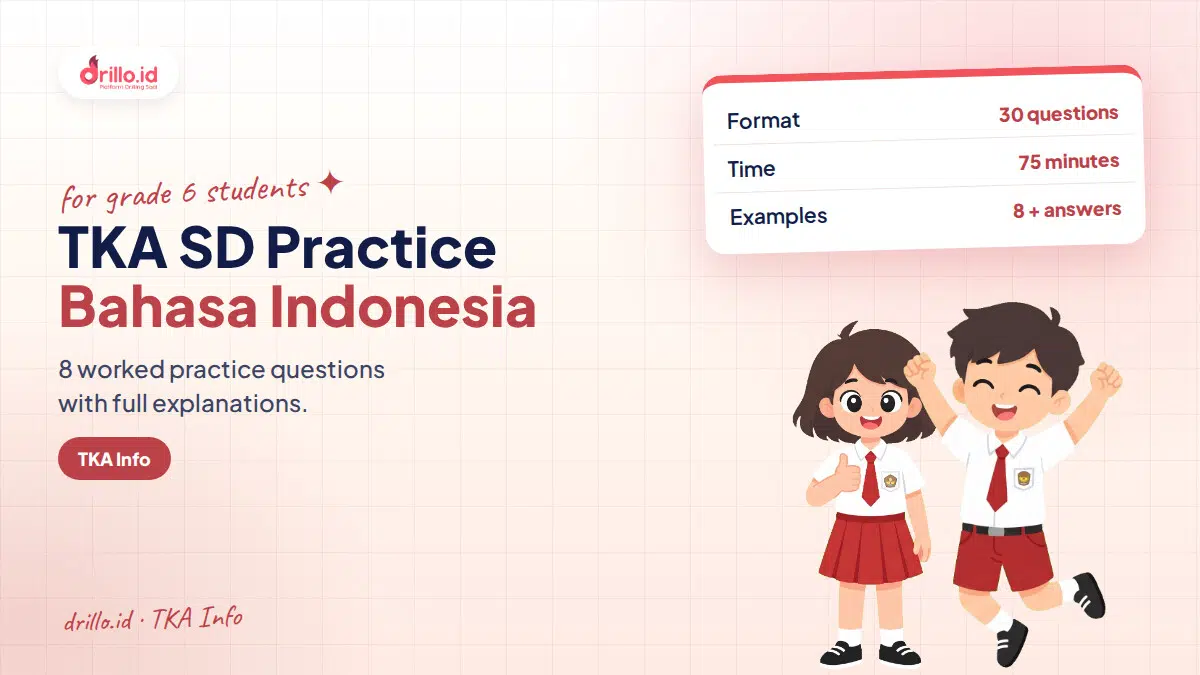
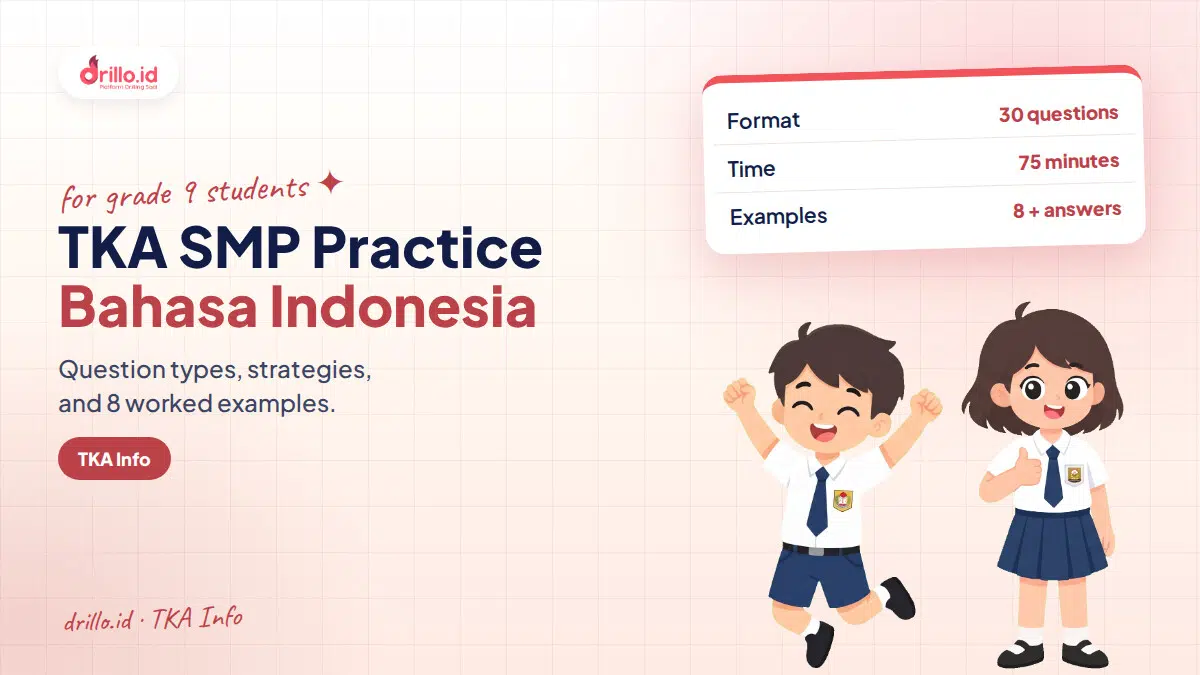
TKA SMP Bahasa Indonesia focuses on reading skills: 30 questions in 75 minutes. Learn the text types and three competencies in the Pusmendik assessment framework, the multiple choice and complex multiple choice formats, test strategies, and eight worked practice examples.
Updated
The 2026 national SMP average for Bahasa Indonesia (Indonesian language) was only 60.83 on a 0-100 scale, so there is still plenty of room to improve. The focus of TKA SMP Bahasa Indonesia is reading skills, not memorising grammar rules. This article covers what is tested, the question types, test-taking strategies, and eight practice examples with full explanations.
A note on language: TKA (Tes Kemampuan Akademik, Indonesia's national academic ability test) Bahasa Indonesia is taken in Indonesian, so the practice texts, questions, and answer options below are kept in Indonesian. The headings, strategies, and answer explanations are in English.
Contents(16)ShowHide
The TKA SMP Bahasa Indonesia format
TKA SMP tests Bahasa Indonesia and Mathematics. According to the session schedule summarised by BBPMP East Java (the ministry's regional education quality assurance office), Bahasa Indonesia has 30 questions to be answered in 75 minutes, or about 2.5 minutes per question.
TKA is not a graduation exam, as stressed in a Kemendikdasmen press release (Kemendikdasmen is the Ministry of Primary and Secondary Education). However, according to the press release on the 2026 TKA results, TKA scores are one component of the SPMB (Sistem Penerimaan Murid Baru, the state school admission system) achievement track. Read TKA SMP and the SPMB achievement track.
What is tested?
According to the TKA SMP assessment framework from Pusmendik (the ministry's Center for Educational Assessment), reading skills are tested on two types of text:
- Informational texts: facts, concepts, or procedures from a range of fields, at local, national, or global scale. These may be single texts or multiple texts.
- Fiction: factual or realist fiction with fully rounded characters, a mixed plot, and a third-person point of view.
Texts are around 200-250 words long (except poetry). The competencies are:
| Competency | Example sub-competencies (assessment matrix) |
|---|---|
| Literal (textual) comprehension | Identifying terms; finding key information stated explicitly; building an outline or diagram |
| Inferential comprehension | Inferring the main idea or values within and across texts; explaining the logic of how ideas connect; predicting events; explaining figurative language and imagery |
| Evaluation and appreciation | Judging how events relate to everyday life; judging whether content is consistent or accurate by comparing texts; inferring emotional responses to fiction |
Question types you should know
The official sample questions on the Pusmendik website use three types:
- Multiple choice (Pilihan Ganda, PG): choose the single best answer from four options.
- Complex multiple choice, MCMA (multiple choice, multiple answers): more than one answer is correct, and you must select all of them.
- Complex multiple choice, category format: assign a category to each statement, for example Benar or Salah (True or False), or Setuju or Tidak Setuju (Agree or Disagree).
One text is usually used for several questions at once.
Strategies for TKA SMP Bahasa Indonesia
- Read the question first, then the text.
- With multiple texts, ask yourself: does the second text support, add to, or contradict the first?
- Watch for figurative language. Figurative expressions often describe how a character feels.
- In complex multiple choice, judge each statement one at a time.
Practice examples with explanations
Note: The questions below are practice examples, not official TKA questions. They were written by the Drillo team to illustrate the competencies in the assessment framework. The texts are shorter than those in the real TKA.
Teks A: Bank sampah di SMP Nusantara mengajak siswa memilah sampah plastik, kertas, dan logam. Setiap setoran ditimbang, lalu nilainya dicatat di buku tabungan siswa. Dalam enam bulan, sampah plastik yang dibuang sekolah ke tempat pembuangan akhir berkurang. Kini, tabungan sampah juga dipakai siswa untuk membeli alat tulis.
Teks B: Tidak semua bank sampah sekolah berjalan lancar. Di beberapa sekolah, setoran justru menurun setelah beberapa bulan karena siswa kehilangan minat. Pengelola menyarankan agar hasil tabungan diumumkan secara rutin dan siswa dilibatkan sebagai pengurus.
Example 1 (multiple choice, relationship between texts)
Hubungan isi Teks A dan Teks B yang paling tepat adalah ....
A. Teks B membantah seluruh isi Teks A.
B. Teks B menunjukkan tantangan yang tidak dibahas dalam Teks A.
C. Teks A dan Teks B membahas sekolah yang sama.
D. Teks B hanya mengulang informasi Teks A.
Answer: B. Text A describes a success story, while Text B discusses problems at other schools. Text B does not contradict Text A; it adds a challenge that Text A does not mention.
Example 2 (complex multiple choice MCMA, literal comprehension)
Pilih semua pernyataan yang sesuai dengan kedua teks.
(1) Setoran sampah di SMP Nusantara ditimbang dan dicatat.
(2) Semua bank sampah sekolah berhasil meningkatkan setoran.
(3) Melibatkan siswa sebagai pengurus disarankan untuk menjaga minat.
(4) Tabungan sampah di SMP Nusantara hanya bisa diambil di akhir tahun.
Answer: (1) and (3). Statement (2) contradicts Text B, which says not every school waste bank runs smoothly, and statement (4) is not mentioned in either text.
Teks C: Nadia meremas lembar pengumuman lomba debat. Namanya tidak tercantum di daftar tim inti. Sore itu langit seakan ikut murung, dan langkahnya terasa berat menuju gerbang sekolah. Di depan gerbang, Bu Ratna memanggilnya. "Tim kita butuh peneliti materi yang teliti. Kamu mau?" Nadia mengangguk pelan, lalu tersenyum kecil untuk pertama kalinya hari itu.
Example 3 (complex multiple choice, category format, figurative language)
Tentukan Benar atau Salah untuk setiap pernyataan berdasarkan Teks C.
(a) "Langit seakan ikut murung" adalah personifikasi yang menggambarkan suasana hati Nadia.
(b) "Langkahnya terasa berat" menunjukkan Nadia kelelahan setelah berolahraga.
(c) Senyum Nadia di akhir cerita menunjukkan perasaannya mulai membaik.
Answer: (a) Benar (True), (b) Salah (False), (c) Benar (True). The sky is given a human quality ("murung", gloomy) to reflect Nadia's disappointment, which makes it personification. "Langkah terasa berat" (heavy steps) describes disappointment, not physical tiredness. Her small smile at the end shows her mood starting to lift.
Example 4 (multiple choice, relevance to everyday life)
Peristiwa yang paling relevan dengan sikap Nadia adalah ....
A. Siswa yang tidak terpilih menjadi pemain inti futsal tetap membantu tim sebagai pencatat statistik.
B. Siswa yang kalah lomba menyalahkan juri.
C. Siswa keluar dari klub karena tidak terpilih.
D. Siswa berpura-pura sakit agar tidak ikut latihan.
Answer: A. Like Nadia, the student who was not picked for the main team still contributes through a different role.
Teks D: OSIS SMP Harapan melakukan survei kepada 120 siswa tentang kebiasaan tidur. Hasilnya, 72 siswa tidur kurang dari tujuh jam pada malam sebelum hari sekolah. Sebagian besar dari mereka mengaku bermain gawai sebelum tidur. Siswa yang tidurnya cukup lebih jarang mengantuk di kelas. Berdasarkan hasil itu, OSIS mengusulkan gerakan "Gawai Tidur Jam Sembilan" agar siswa beristirahat lebih awal.
Example 5 (multiple choice, literal comprehension with numbers)
Persentase siswa yang tidur kurang dari tujuh jam berdasarkan Teks D adalah ....
A. 40%
B. 48%
C. 60%
D. 72%
Answer: C. . Option D is the number of students, not the percentage. Options A and B come from calculating the students who sleep enough instead ().
Example 6 (complex multiple choice MCMA, inferential comprehension)
Pilih semua simpulan yang didukung Teks D.
(1) Kebiasaan bermain gawai sebelum tidur diduga berkaitan dengan kurang tidur.
(2) Semua siswa SMP Harapan kurang tidur.
(3) Gerakan yang diusulkan OSIS bertujuan agar siswa beristirahat lebih awal.
(4) Siswa yang tidurnya cukup tidak pernah mengantuk di kelas.
Answer: (1) and (3). Conclusion (1) is supported by the sentence saying most of the students who sleep too little use their devices before bed. The word diduga (thought to be) fits because the text does not prove cause and effect. Conclusion (3) is stated directly. Conclusion (2) is wrong because only 72 of 120 students sleep too little, and (4) is too absolute because the text says lebih jarang (less often), not never.
Example 7 (multiple choice, choosing a title)
Judul yang paling tepat untuk Teks D adalah ....
A. Gawai Tidur Jam Sembilan: Usulan OSIS dari Hasil Survei Tidur Siswa
B. Cara Membuat Survei di Sekolah
C. Bahaya Gawai bagi Kesehatan Mata
D. Daftar Siswa yang Sering Mengantuk di Kelas
Answer: A. A good title covers the main content of the text: the survey results and the OSIS proposal. Options B, C, and D are either not discussed or only touch a small part of the text.
Example 8 (complex multiple choice, category format, evaluating information)
Tentukan Benar atau Salah untuk setiap pernyataan berdasarkan Teks D.
(a) Survei melibatkan seluruh warga sekolah, termasuk guru.
(b) Usulan OSIS didasarkan pada hasil survei.
(c) Teks menyebutkan secara langsung jumlah siswa yang tidurnya cukup.
Answer: (a) Salah (false), (b) Benar (true), (c) Salah (false). The survey only involved 120 students. The OSIS proposal is explicitly based on the results ("berdasarkan hasil itu"). The number of students who sleep enough is not stated directly, although it can be calculated (). This is the difference between stated information and information you have to infer.
Tips for parents
- Read news or popular articles with your child for 15-20 minutes a day, then ask them to name the main idea.
- Compare two news stories on the same topic to practise multiple-text questions.
- Talk about how the characters feel in short stories for teenagers.
- Check your region's SPMB guidelines (juknis) to see how TKA scores are used on the achievement track.
Note: Kemendikdasmen has set the official TKA SMP 2027 schedule: registration January 6 to February 7, SMP/MTs dress rehearsal February 15 to 18, the SMP/MTs test itself March 29 to April 1, 2027, make-up test April 19 to 22, and results announced May 14, 2027, as reported by Medcom. This is earlier than TKA SMP 2026, which ran April 6 to 16, 2026. Full details are in the official 2027 TKA calendar for primary and junior secondary school.
Measure your skills with a free tryout
Try a full set in the Free TKA SMP Tryout. Each subject has 30 questions in 75 minutes, complete with explanations and a breakdown by subtest. Then move on to TKA SMP Mathematics practice questions.
References
- Pusmendik Kemendikdasmen - Kerangka Asesmen TKA Jenjang SMP/MTs/Sederajat: Bahasa Indonesia (in Indonesian)
- Kemendikdasmen - TKA SD dan SMP 2026 Digelar April, Kemendikdasmen: Pemetaan Mutu, Bukan Penentu Kelulusan (in Indonesian)
- Kemendikdasmen - Hasil TKA 2026 Resmi Dirilis, Kemendikdasmen Dorong Evaluasi Pembelajaran yang Lebih Presisi (in Indonesian)
- BBPMP Jawa Timur - Ini Jadwal Lengkap TKA SD dan SMP 2026 dan Sesinya (in Indonesian)
- Medcom - Jadwal TKA 2027 SD/MI dan SMP/MTs Diumumkan, Pendaftaran Dibuka 6 Januari (in Indonesian)

Written by
Sarah Sasmita
Penulis Informasi dan Edukasi Drillo.id
Membahas informasi pendidikan, tips dan strategi belajar, persiapan ujian dan seleksi, sampai pengembangan kompetensi dan karier. Fokusnya TKA, UTBK-SNBT, sekolah kedinasan, CPNS dan PPPK, BUMN, serta TOEFL. Menyajikan informasi yang mudah dipahami dan mengacu pada sumber tepercaya.